
Pier and Beam architectures offer unique character and charm throughout the Austin area.
If you live in the heart of Austin—in the tree-lined streets of Tarrytown, the historic blocks of Hyde Park, or the bungalow-filled lanes of Crestview—you likely appreciate the architectural character of the historical style pier and beam home. These structures, elevated above the ground on concrete or cedar posts, offer a classic aesthetic and essential ventilation for the Texas heat.
However, that same elevation creates a dark, cool, and protected void beneath your floorboards: the crawl space. To a human, it’s a maintenance access point. To a skunk, opossum, or raccoon, it’s a luxury subterranean suite.
At Prickly Pear Wildlife Removal, we have spent years crawling through the dirt of Central Austin to solve what we call “The Pier-and-Beam Problem.” Here is everything you need to know about why your foundation is a wildlife magnet and how to secure it for good.
The Magnetism of the Central Austin Crawl Space
Why do animals choose a pier and beam crawl space in Tarrytown over a hollow log in a nearby park? The answer lies in the unique microclimate and safety of Central Austin neighborhoods.
1. Temperature Regulation
Texas summers are brutal. A pier-and-beam foundation acts as a natural heat sink. The shaded earth beneath the house stays significantly cooler than the surrounding environment. Conversely, in the winter, the residual heat escaping through your floorboards provides a warm sanctuary against Northers.
2. Protection from Predators
In an urban environment, the “big three” (raccoons, skunks, and opossums) have few natural predators other than cars and dogs. A crawl space with a narrow opening provides a defensible position where they can raise young without fear of being ambushed.
3. Proximity to “Resources”
Hyde Park and Tarrytown are “resource-rich” environments. Between overflowing bird feeders, outdoor cat food, and the heavy-duty trash cans that raccoons treat like a five-star buffet, your home is essentially the center of a wildlife food court.
4. Access to your air conditioning Ducts!
Raccoons (and other wildlife) love to be comfortable and in the Austin heat, tearing open an AC duct provides a blast of cool air. Not only that, but once they have an opening these ducts provide secure access to every part of your home, making resource gathering a breeze.
The Neighborhood Breakdown: Tarrytown vs. Hyde Park
While both neighborhoods share the pier-and-beam struggle, the specific challenges can vary based on the age and style of the home.
Tarrytown: The “Heritage Oak” Highway
In Tarrytown, the massive canopy of heritage oaks provides a direct highway for raccoons. They use the branches to access your roof, but once they realize the “basement” is easier to get into, they head for the foundation. Tarrytown homes often feature decorative lattice that has become brittle over time. A 15-pound raccoon doesn’t need a door; it simply pushes through the rotted wood.
Hyde Park: The Historic Bungalow Gap
Hyde Park’s classic bungalows often feature brick or stone skirting. While this looks sturdier than lattice, the “gaps” are often found where the porch meets the main foundation. Over decades, the soil settles, creating “sinkholes” or “settlement gaps” that are just large enough for a skunk to squeeze through.
Why “Lattice” and “Chicken Wire” Fail
Many homeowners try to solve the pier-and-beam problem with a trip to a big-box hardware store. They buy a roll of chicken wire or a new piece of wooden lattice and staple it to the frame. Within weeks—sometimes days—the animals are back.
- The Strength Issue: Raccoons have incredible manual dexterity and strength. They can pull staples right out of wood.
- The Burrowing Issue: Skunks and armadillos don’t go through the fence; they go under it. If your barrier stops at the grass line, it isn’t a barrier; it’s a suggestion.
- The Corrosion Issue: Standard chicken wire is thin and rusts quickly when in contact with Central Austin’s damp soil, becoming brittle and useless within a single season.
The Prickly Pear Solution: Dig proofing and Wildlife Fencing
To solve the pier-and-beam problem permanently, you have to think like a burrower. At Prickly Pear, we don’t just “cover” the gap; we harden the perimeter using a process called dig proofing.
Phase 1: The Excavation
We begin by digging a shallow, narrow trench around the entire perimeter of the crawl space or deck. This is a labor-intensive process, especially in the rocky soil found in parts of West Austin, but it is the most critical step.
Phase 2: The Hardware Cloth
We use heavy-duty, 19-gauge hot dipped double galvanized PVC coated mesh. Unlike chicken wire, this material is chew-proof and rust-resistant and is rated for ground contact We attach the top of the mesh securely to the base of the house using specialized fasteners that won’t pull out.
Phase 3: The “L-Shape” Bend
This is the “secret sauce” of a professional exclusion. Instead of just dropping the wire straight down, we bend the bottom 6 to 12 inches outward into an “L” shape at the bottom of the trench.
When a skunk or armadillo tries to dig under your house, they hit the vertical wire. They move back a few inches and try again, only to hit the horizontal “L” part of the mesh. Their instinct tells them they can’t get under, and they move on to an easier target.
Phase 4: Backfill and Finish
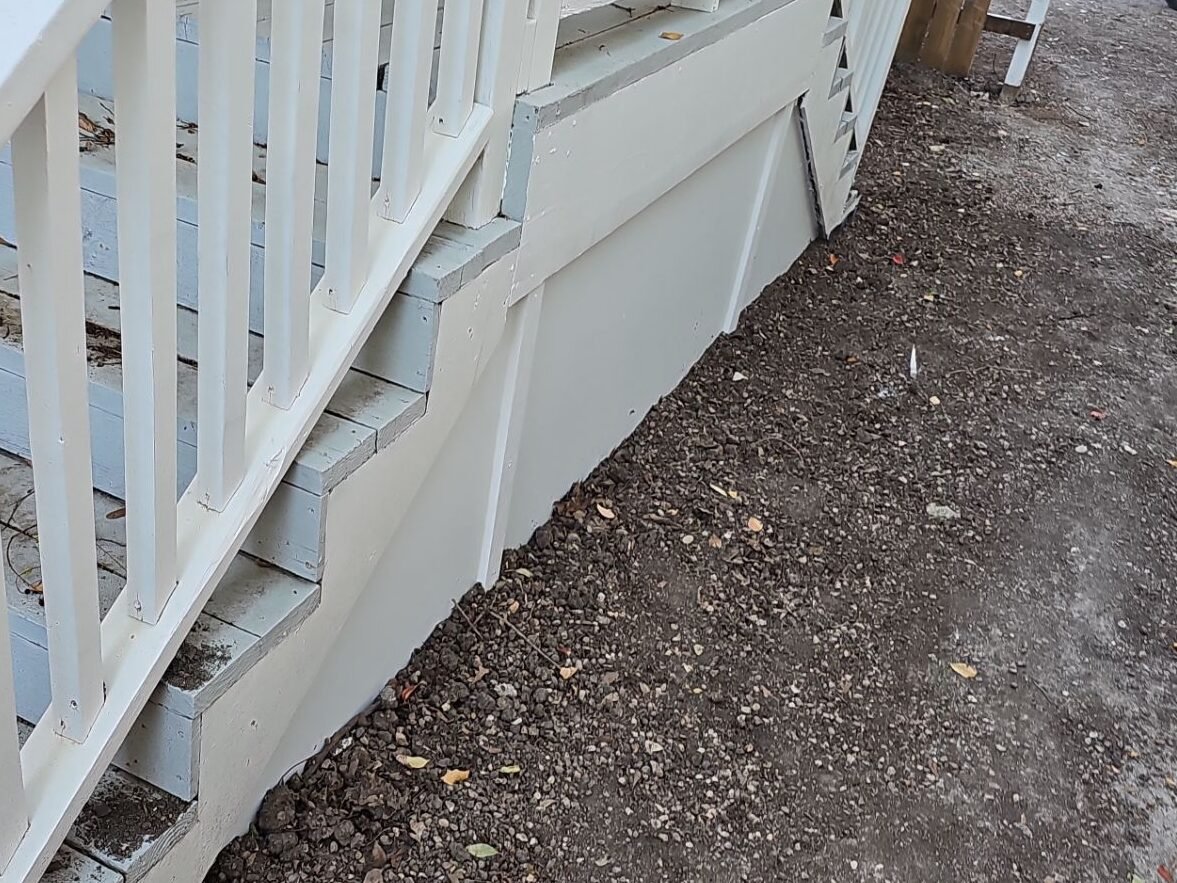
We backfill the trench with soil or decorative stone. The result is a nearly invisible, permanent barrier that allows your foundation to breathe (preventing wood rot and mold) while keeping 100% of the wildlife out.
The “One-Way Door” Policy: No Animal Left Behind
One of the biggest fears homeowners have is: “What if you seal the animal INSIDE?”
This is a valid concern. Sealing an animal under your home is not only inhumane, but it also leads to the nightmare scenario of a deceased animal under your floorboards—a smell that can linger in a Hyde Park bungalow for weeks.
At Prickly Pear, we use One-Way Exclusion Doors.
- We complete the trench screening on 95% of the house.
- At the main entry point, we install a specialized door that allows the animal to push its way out to go find food at night.
- The door is designed so that it cannot be pushed open from the outside.
- Once our cameras confirm the “tenants” have vacated, we remove the door and complete the final seal.
Maintaining the Integrity of Your Central Austin Home
While this trench screening is the “silver bullet” for foundations, a holistic approach to wildlife management is the best way to keep your property quiet.
- Trim the Canopy: Keep those Tarrytown oaks trimmed at least 6–8 feet away from your roofline.
- Secure the Perimeter: If you have a deck, it needs the same trench screening treatment as your foundation.
- Manage the Buffet: Use locking trash lids and never leave pet food out overnight.
- Protect the Home: Inspect the whole home looking for soft spots and alternative entrances into the home.
Conclusion: Protect Your Historic Investment
Your Central Austin home is more than just a building; it’s a piece of Austin’s history. Whether you’re dealing with the midnight “thumping” of a raccoon or the unmistakable “perfume” of a skunk under your Hyde Park ranch, you don’t have to live with the stress of wildlife intruders.
Prickly Pear Wildlife Removal is locally owned and operated right here in Pflugerville. We know the architecture of Central Austin, we know the habits of Texas wildlife, and we know how to fix the pier-and-beam problem for good. Reach out today to talk about your specific home.