
For residents of Round Rock, particularly in the sprawling, beautiful golf course communities of Teravista and Forest Creek, the manicured lawn is a point of pride. We invest in professional landscaping, irrigation systems, and seasonal treatments to maintain that perfect “Texas green.”
However, as development continues to expand towards the surrounding areas, the local wildlife is being pushed out of their natural habitats and right into our backyards. If you’ve ever woken up to find your yard looking like a miniature construction site—filled with shallow holes, upended sod, and mysterious “cones”—you aren’t alone. You are facing the “Lawn Warriors”: Armadillos and Skunks.
At Prickly Pear Wildlife Removal, we don’t just treat these animals as a nuisance; we understand the biology behind their behavior. In this guide, we’ll break down why Round Rock has become a hotspot for these ground-dwelling diggers and how our specialized “Sub-Deck Exclusion” process is the only permanent way to protect your property.
The Displacement Effect: Why Round Rock is “Digging” Central
Round Rock is one of the fastest-growing cities in the United States. While this growth is great for our economy, the rapid conversion of limestone scrubland and open fields into residential neighborhoods has created a massive displacement of native Texas wildlife.
1. The Grubs and the Greenery
The very thing we do to make our lawns beautiful—regular watering and fertilization—makes them irresistible to armadillos and skunks. Moist soil is easier to dig through, and healthy turf is a breeding ground for beetle larvae (grubs) and earthworms. To an armadillo, your Teravista lawn isn’t just a yard; it’s an all-you-can-eat buffet.
2. The Old Settlers Park “Green Belt”
Neighborhoods like Forest Creek are situated near major green belts and the massive 645-acre Old Settlers Park. These areas act as wildlife “corridors” connected with waterways, creeks, and green belts. Animals use these protected zones to travel safely, but they often “commute” into nearby residential yards at night to forage.
3. The Lack of Natural Predators
In the wild, coyotes and bobcats keep armadillo and skunk populations in check. In a master-planned community, those predators are gone. Without natural checks and balances, a single pair of skunks under a backyard deck can quickly turn into a multi-generational problem for the entire cul-de-sac.
Know Your Enemy: Armadillos vs. Skunks
While both animals will destroy your landscaping, their motivations and the signs they leave behind are slightly different.
The Nine-Banded Armadillo: The “Tank”
Armadillos are essentially biological bulldozers. They have poor eyesight but an incredible sense of smell. They can detect a grub three inches underground while walking.
- The Damage: They create “divots” or cone-shaped holes. Because they are focused on food, they will keep digging until the entire yard is pockmarked.
- The Den: They prefer to burrow under concrete slabs, AC pads, or—most commonly in Round Rock—under the wooden decks of backyard patios.
The Striped Skunk: The “Stinky Resident”
Skunks are also diggers, but their damage is usually shallower. They “peel” back sod in search of insects.
- The Damage: You’ll see broader, shallower patches of disturbed grass compared to the deep holes of an armadillo.
- The Den: Skunks are “lazy” homeowners. They prefer to find an existing cavity rather than dig a fresh hole. The hollow space under a porch or a storage shed in a Forest Creek backyard is their idea of a five-star hotel.
- The Risk: Beyond the damage to your lawn, skunks bring the obvious risk of spraying pets and children, as well as being a primary carrier of rabies in Central Texas.
Why Trapping Alone is a Losing Battle
Many homeowners in Round Rock neighborhoods like Forest Creek start by calling an exterminator or buying a “Live Trap” from a local hardware store. While you might catch the resident armadillo, you haven’t solved the problem.
When you remove an animal from under your deck but leave the hole open, you have created a “turnkey” property for the next animal passing through. In a high-density wildlife area like Round Rock, a vacant den will be re-occupied within weeks. You’ll find yourself in a never-ending cycle of trapping and paying for removals.
The Prickly Pear Solution: Sub-Deck & Porch Exclusion
To stop the cycle, you have to “harden” your property. At Prickly Pear, we specialize in Sub-Deck Exclusion—a permanent, physical barrier that makes it impossible for wildlife to live under your structures.
Step 1: Humane Trapping and Removal
We begin by removing the current residents. We use species-specific baits and check our traps daily to ensure the process is as humane and stress-free for the animal as possible.
Step 2: The Trenching Process
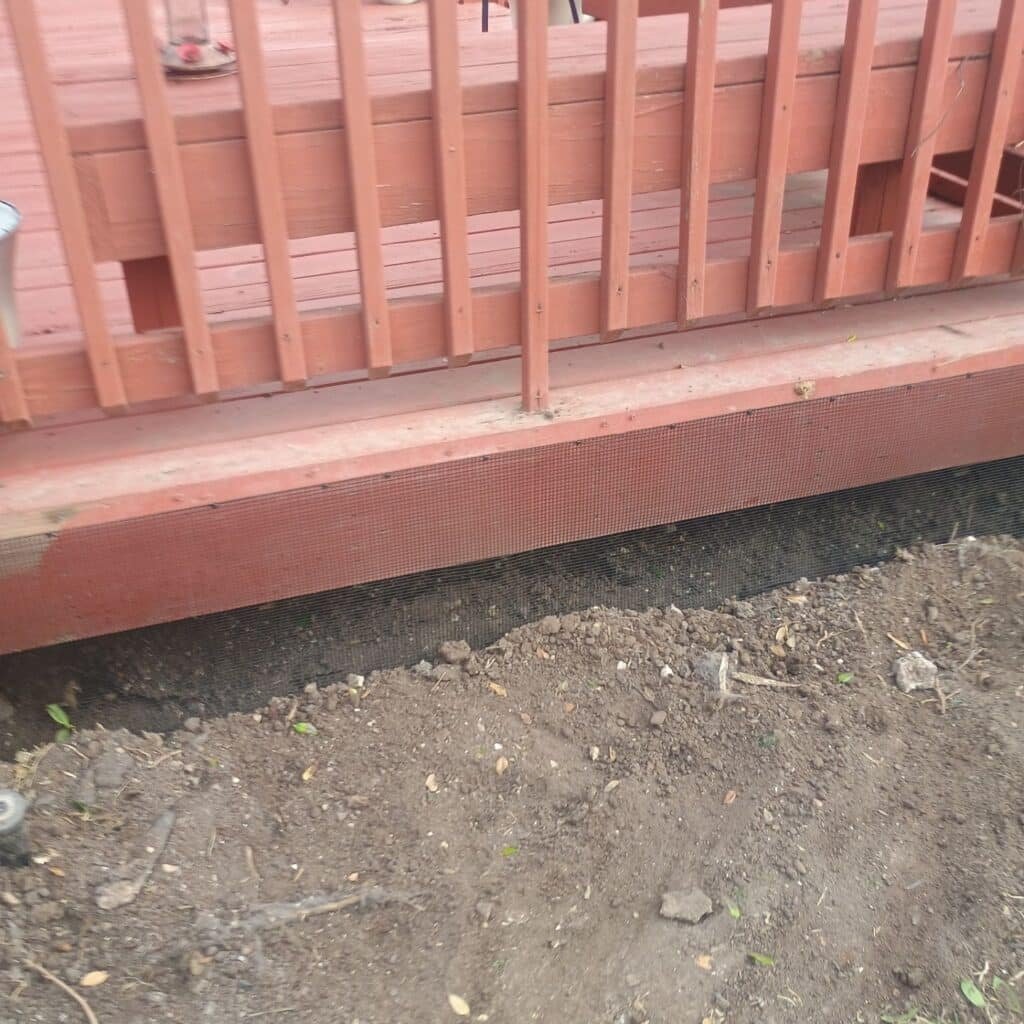
This is where we differ from the “quick-fix” companies. We dig a 12-inch deep trench around the entire perimeter of your deck, porch, or shed.
Step 3: Hardware Cloth Installation
We install heavy-duty, 19-gauge galvanized steel wildlife fencing. This mesh is chew-proof and rust-resistant.
- The “L-Header”: We don’t just put the mesh straight down. We bend the bottom of the mesh outward into an “L” shape at the bottom of the trench.
- The Biological Block: When a new armadillo comes along and tries to dig under your deck, it hits the mesh. Its instinct is to move back and dig deeper, but it immediately hits the horizontal “L” part of the steel. It quickly realizes it cannot get through and moves on to your neighbor’s (unprotected) yard.
Step 4: Deodorizing and Sanitation
Wildlife leaves behind pheromones that act as a “scent trail” for others. We treat the area under the deck with professional-grade enzymatic cleaners that break down these scents, effectively “deleting” your home from the wildlife map.
Protecting the Investment of Round Rock Homeowners
We know that a home in Teravista or Forest Creek is a significant investment. Beyond the aesthetic damage to your lawn, armadillos and skunks can cause structural issues:
- Foundation Erosion: Deep burrows under AC pads or concrete porches can cause the ground to shift and crack.
- Electrical Risks: Animals living under decks often chew on low-voltage lighting wires or irrigation lines.
- Pet Safety: Encounters between dogs and skunks often result in expensive (and smelly) trips to the vet.
Conclusion: Take Back Your Turf
You don’t have to spend your Saturday mornings filling in holes or worrying about your dog getting sprayed. By combining humane removal with professional-grade exclusion, you can protect your landscaping once and for all.
Prickly Pear Wildlife Removal is proud to serve the Round Rock community from Terravista to Forest Creek and everywhere in between We understand the specific soil conditions, neighborhood layouts, and wildlife habits of the area. We aren’t just trappers; we are “Lawn Warriors” who believe that the best wildlife management is a permanent solution.